Nils Birger Hansell’s Famous 1953 “Wonders of New York.”
Wonders of New York.
$1,800
1 in stock
Description
Not every map becomes the defining image of its genre. Nils Birger Hansell’s Wonders of New York did: it was chosen as the cover of Stephen Hornsby’s Picturing America: The Golden Age of Pictorial Maps, the standard scholarly study of the American pictorial map tradition.
The honor is merited. Hansell brought to this map a lifetime of experience (journalism, trucking, wartime service in North Africa and India, solo canoe voyages down the Danube), and the eye of a professional art director who spent his postwar career at IBM. The result is a cartographic encyclopedia of New York’s wonders, eccentricities, legends, and outright absurdities, rendered in vivid color and detail.
The Map in Detail
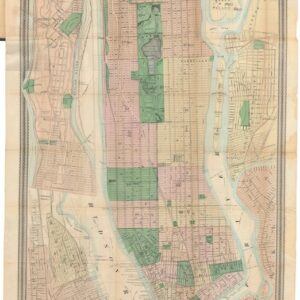
The map covers Manhattan from the Battery to roughly 96th Street in a bird’s-eye view looking northward, the Hudson at left and the East River at right. The island is rendered block by block in warm orange, with individual skyscrapers in yellow and gold, parks in green, churches and landmark buildings in contrasting colors. The composition is dense and layered. Some 301 points of interest are numbered throughout the image, each keyed to a legend running along the inner border, so that every numbered site can be identified and every annotation read.
The Hudson is populated with named ships, each rendered with enough detail to identify the livery: the Queen Elizabeth, the Liberté, the S.S. Constitution, the S.S. United States, and the Oslofjord; this last perhaps a nod to Hansell’s Swedish heritage. The U.S.S. Midway, the largest ship in the world until 1955, appears in the lower right of the harbor. At the docks along the river, the shipping companies and cruise lines are individually identified.
Running across Manhattan’s elevated streets, Hansell illustrates the last of New York’s elevated railway lines, a deliberate inclusion, since the final section of the Third Avenue El was demolished in 1955, just two years after this map was published. And in the East River, a color-coded diagram of the subway system divides the lines by their operators: the BMT, the IND, and the IRT.
The annotations are where the map fully reveals itself. Among the 301 entries: the building at 260 Madison Avenue where, Hansell records, only beautiful redheaded women were hired to operate the elevators (#179). The old Syrian Quarter (#9). The spot where the pirate Captain Kidd is said to have buried his treasure (#77). Shinbone Alley (#96), identified as the home of Archy, the philosopher-cockroach who typed his essays by hurling himself head-first at the keys at night, and Mehitabel, the cat on her ninth life; characters from Don Marquis’s celebrated newspaper columns. And the obscure provision of city law under which Trinity Church retains the right to claim any whale caught in the Hudson River.
Among the figures identified is Bowery Mose, also known as Mose the Fireboy, a kind of New York Paul Bunyan said to have stood eight feet tall, worked as a fireman with Company 49 on the Lower East Side, deadlifted trolley cars, and crossed the Hudson in two strokes. His legend, rooted in the real figure of Moses Humphrey, a grocer, printer, and member of the Bowery Boys, was the nearest thing New York had to a folk hero.
The outer border is a continuous illustrated frieze of New Yorkers at work and play: construction workers, shoppers, musicians, tourists, subway riders, street vendors. In the lower right corner, the artist himself appears — seated at his easel, drawing the map you are looking at.
Publication History and Census
Published by Nils Hansell, North Stonington, Connecticut, August 1953. Lithographed in U.S.A. by Lutz & Sheinkman. The OCLC records four institutional examples. One copy is held in the David Rumsey Map Collection at Stanford University.
Cartographer(s):
Nils Birger Hansell (1909–1989) was a Swedish-American illustrator, adventurer, and graphic artist whose life resisted any single category. Born in Cadwell, New Jersey to Swedish immigrant parents — his mother designed sets for the Greenwich Village Follies, his father was a mining engineer — Hansell studied at the Fieldston Academy in the Bronx, attended the Experimental College at the University of Wisconsin, and trained at the Columbia Graduate School of Journalism before taking a position at the American Bankers’ Association Journal in 1933. Restlessness carried him to Texas, where he built and sold a fleet of tractor-trailers before being drafted into the Army and serving with the Air Transport Command in North Africa, the Middle East, and India. After the war he made solo canoe voyages down the Danube and through the Erie Canal, then settled back in New York as a graphic artist at IBM, where he served as Art Director of the IBM Journal of Research and Development.
Condition Description
Good. Wear along fold lines. Some chips along edge.
References