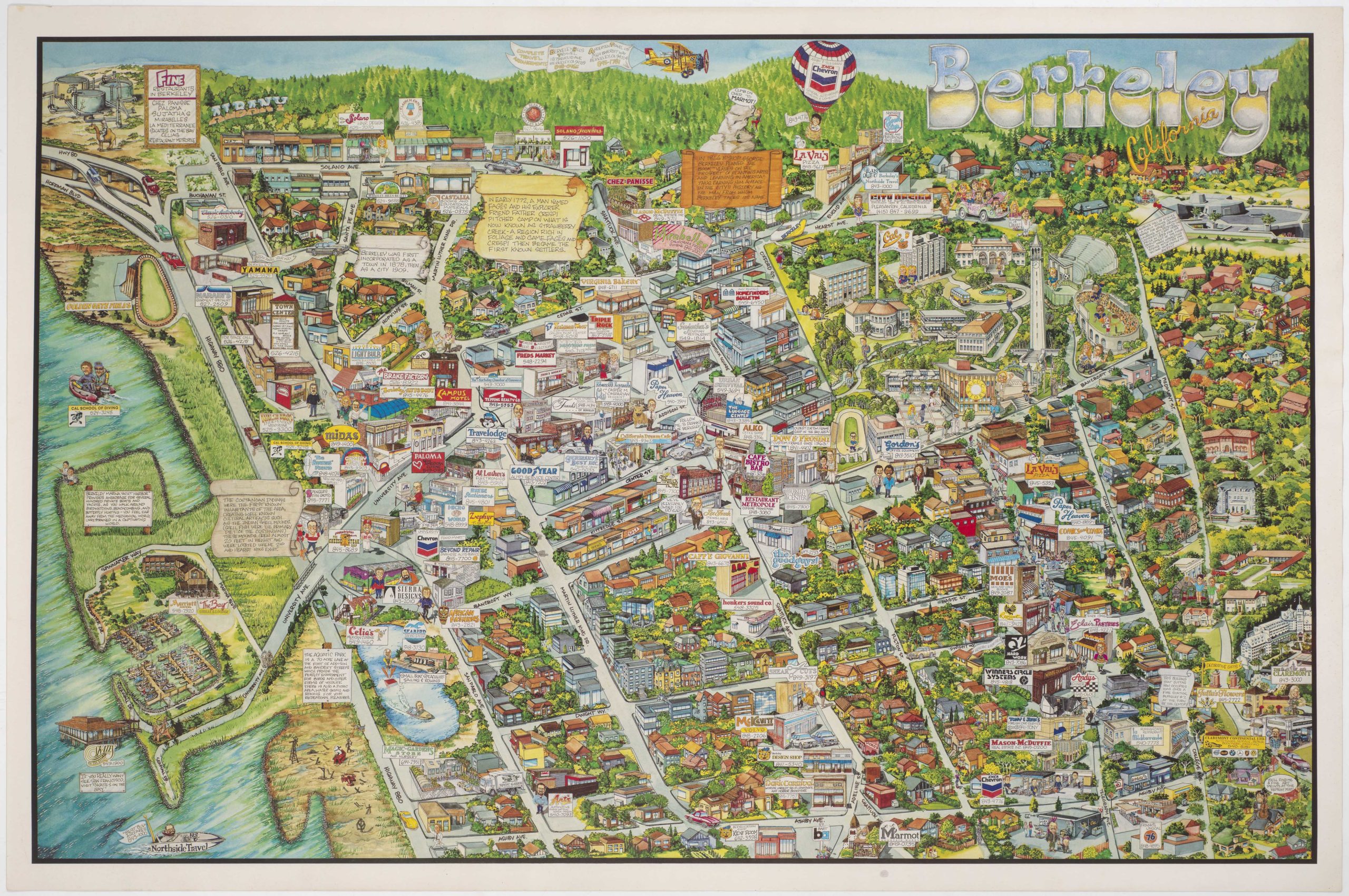
A colorful 1988 promotional pictorial view of Monterey’s famous Cannery Row.
Monterey California. Cannery Row.
$275
1 in stock
Description
This playful 1988 pictorial view of Monterey highlights the city’s famed Cannery Row waterfront neighborhood. It is oriented roughly towards the southwest, presenting the northern coast of the Monterey Peninsula from Point Pinos Lighthouse to Fisherman’s Wharf. Local landmarks, including the Monterey Bay Aquarium, Pacific Biological Laboratories (managed by local legend and pioneering marine biologist Edward F. Ricketts), and Hopkins Marine Station, are highlighted, as are several local businesses and attractions. An unusually high percentage of these are still in operation (El Torito, Domenico’s, Fisherman’s Grotto, to name a few), suggestive of Monterey’s successful reinvention as a tourist destination.
Now one of the most distinctive and charming waterfronts in California, Cannery Row was anything but when it was immortalized in fiction (1945 novel Cannery Row and 1948 novel Sweet Thursday, especially) by John Steinbeck, whose portrait appears at top. The abundant sealife of Monterey Bay has always attracted anglers, from Native Americans to early Chinese immigrants and many others. In the early 20th century, sardine fishing and canning operations were boosted to an industrial scale by local businessman Frank E. Booth (referred to at left here), who hired Norwegian fishermen to advise him on best techniques, the most important being Knut Hovden, who later became Booth’s competitor.
By the late 1910s, Booth, Hovden, and others operated large-scale canning operations collectively producing over a million cans per year. The industry peaked from the 1920s through the end of World War II, employing a workforce of thousands hailing from countries around the world, though the largest portion were Sicilian women. The work was highly seasonal, following the migrations of sardines, and work days were long during the busiest months. In the post-World War II period, several factors (including overfishing) combined that led to the decline of the industry. However, the area quickly revived as a major tourist destination and continues to thrive in that role today.
This view was drawn by Arlon Gilliland in 1988. It is not cataloged among any institutional collections.
Cartographer(s):
Condition Description
Very good.
References