
John Russell Bartlett was born on October 23, 1805, in Providence, Rhode Island, and came to cartographic prominence through an unlikely combination of scholarship, politics, and adventure. Trained not as a surveyor but as a bookman — he ran a celebrated antiquarian bookshop in New York and co-founded the American Ethnological Society — he was appointed United States Boundary Commissioner in 1850, charged with surveying and marking the new border between the United States and Mexico following the Treaty of Guadalupe Hidalgo. Over three years of grueling fieldwork in Texas, New Mexico, Arizona, California, and Sonora, his commission produced the surveys that mapped the southwestern borderlands for the first time at a systematic scale. The experience yielded his two-volume Personal Narrative of Explorations and Incidents (1854), one of the great firsthand accounts of the antebellum Southwest, as well as the boundary maps issued by the commission.
His surveyorship was not without controversy — disputes over the precise line at issue contributed to the Gadsden Purchase of 1853 — and he was removed from the post before the work was fully complete. He returned to Rhode Island, serving as Secretary of State from 1855 to 1872, and spent his later years as librarian to the John Carter Brown collection at Brown University, one of the finest early Americana libraries in existence. He died on May 28, 1886. His Dictionary of Americanisms (1848) remains a landmark in American linguistic history.
-
-
Add to cart
 Quick View
- Texas and The West, United States
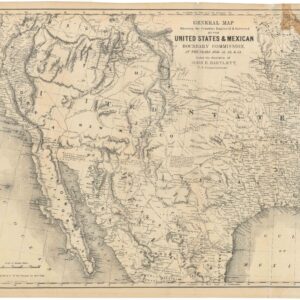
General Map Showing the Countries Explored & Surveyed By The United States & Mexican Boundary Commission In the Years 1850, 51, 52 & 53. Under the direction of John R. Bartlett
- $475
- 1854 Colton/Bartlett Map of the U.S.-Mexican Boundary Survey, Showing the Controversial Boundary Line That Prompted the Gadsden Purchase.
-
-