
Jefferson Davis (1808–1889) was born in Kentucky and raised in Mississippi, graduating from West Point in 1828 and serving in the Army through the Black Hawk War before resigning to become a cotton planter. He returned to public life as a Mississippi congressman and then distinguished himself commanding the 1st Mississippi Rifles at the Battle of Buena Vista in the Mexican-American War, a performance that made him a national figure and launched his senatorial career. By the time President Franklin Pierce appointed him Secretary of War in 1853, Davis was among the most capable administrators in Washington — methodical, technically minded, and deeply invested in the modernization of the American military.
His tenure as Secretary of War from 1853 to 1857 was genuinely consequential. He introduced rifled muskets to the infantry, experimented with a camel corps for desert operations in the Southwest, and — most relevant here — secured the congressional appropriation that funded the Pacific Railroad Surveys. Davis personally favored the southernmost route, along the 32nd parallel from Texas along the Gila River to San Diego, a preference that was partly practical and partly sectional: a southern terminus would anchor the transcontinental railroad in territory friendly to Southern interests. The surveys he ordered were scrupulously conducted; the route he preferred was not chosen. Davis returned to the Senate in 1857, resigned when Mississippi seceded in 1861, and became President of the Confederate States of America — meaning that the final volume of the survey he had ordered appeared in the same year he took office in Montgomery. He was captured by Union forces in 1865, imprisoned for two years at Fort Monroe, and never tried for treason. He spent his remaining years in Mississippi and died in New Orleans in 1889, the last significant figure of the Confederate leadership to go.
-
-
Add to cart
 Quick View
 - Texas and The West
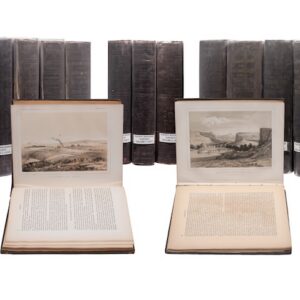
PACIFIC RAILROAD SURVEYS. Reports of Explorations and Surveys, to Ascertain the Most Practicable and Economical Route for a Railroad from the Mississippi River to the Pacific Ocean, Made Under the Direction of the Secretary of War, in 1853-4. Washington, D.C.: Beverley Tucker, 1855-1861.
- $6,000
- The Complete Pacific Railroad Surveys, Senate Issue, 1855–1861.
-
-