
Carleton E. Watkins (1829–1916) was one of the pre‑eminent photographers of the nineteenth‑century American West, celebrated for his technically refined mammoth‑plate landscapes and for images that played a consequential role in shaping public perceptions of the West. Born in New York State, he moved to California during the Gold Rush and by the late 1850s had established himself as a professional photographer in San Francisco, where he opened studios and undertook extensive field campaigns to Yosemite, the Columbia River, and various mining districts.
In the 1860s, Watkins had a special mammoth‑plate camera built that could expose glass negatives approximately 18 by 22 inches, enabling him to make contact prints of unprecedented scale and clarity, which he marketed to wealthy patrons, scientific institutions, and government bodies. His Yosemite photographs, commissioned in part by the California State Geological Survey, were exhibited in the East and contributed to the conservationist sentiment that culminated in the designation of Yosemite as protected land.
After the economic downturn of the 1870s, Watkins’s career was marked by financial instability, competition from other photographers, and the loss of some negatives in a studio foreclosure. Yet, he continued to produce mammoth‑plate and smaller‑format images into the 1880s, including significant bodies of work on San Francisco, the Comstock mines, and California agriculture. In his final years, Watkins suffered from ill health and poverty and died in 1916. Still, in the twentieth and twenty‑first centuries, his work has been widely reassessed, and he is now regarded as a central figure in both the artistic and documentary traditions of American photography.
-
-
Add to cart
 Quick View
 - California, San Francisco
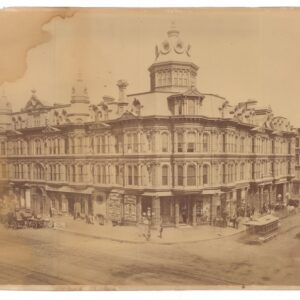
Grand Hotel, Johnson & Co., Proprietors, San Francisco, California.
- $3,200
- Carleton Watkins mammoth plate of San Francisco’s Grand Hotel (CEW 382).
-
-
Archived
- Out of Stock
![[Photographs of early San Francisco]](https://neatlinemaps.com/wp-content/uploads/2023/03/NL-01645-composite_thumbnail-300x300.jpg)
- San Francisco
[Photographs of early San Francisco]
- Incredible photographs from the early days of San Francisco.
- Read moreQuick View
-