
Captain Greenville Collins (c. 1643–1694) was an English naval officer and pioneering hydrographer whose work laid the foundation for systematic coastal charting in Britain. Serving in the Royal Navy during the late seventeenth century, Collins gained practical experience in navigation and surveying at a time when reliable nautical charts of British waters were scarce. Recognizing the strategic and commercial importance of accurate maritime information, the English crown commissioned him in the early 1680s to conduct a detailed survey of the coasts of England and Wales.
Between roughly 1681 and 1688, Collins directed an extensive hydrographic survey of the English coastline, measuring depths, mapping shoals and sandbanks, and documenting harbors and navigational hazards. His work represented one of the first coordinated national charting efforts in England. The results were compiled into Great Britain’s Coasting Pilot, first published in 1693. The volume combined detailed engraved charts with sailing directions and coastal views, providing mariners with far more reliable guidance than previously available.
Collins’s atlas became the standard reference for navigation around British waters for decades and marked an important step in the professionalization of hydrography in England. His methods and charts influenced later surveying practices and helped improve maritime safety during a period of expanding naval power and overseas trade. Collins died in 1694, only a year after the publication of his landmark work, but his contributions established him as one of the earliest significant hydrographers of the British Isles.
-
-
Add to cart
 Quick View
 - British Isles, Europe
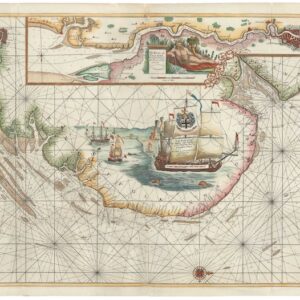
The River of Thames from London to the Buoy of the Noure.
- $1,800
- 1693 ca. Collins Nautical Chart of the Thames Estuary, with Inset Town Plan and Fleet Cartouche.
-
-
-
-
Add to cart
![[The Isle of Wight and the Solent Approaches]](https://neatlinemaps.com/wp-content/uploads/2026/05/NL-02635_thumbnail-300x300.jpg) Quick View
Quick View - British Isles, Europe
[The Isle of Wight and the Solent Approaches]
- $800
- 1693 Collins Nautical Chart of the Isle of Wight, the Solent, and the Approaches to Portsmouth and Spithead.
-
-
-
-
Add to cart
![[Kingsale Harbour]](https://neatlinemaps.com/wp-content/uploads/2026/05/NL-02634_thumbnail-300x300.jpg) Quick View
Quick View - British Isles, Europe
[Kingsale Harbour]
- $400
- 1693 Collins Nautical Chart of Kinsale Harbour, with Plans of Charles Fort and Rincorran Castle.
-
-
-
-
Add to cart
![[The Chiefe Harbours in the Islands of Orkney]](https://neatlinemaps.com/wp-content/uploads/2026/05/NL-02632_thumbnail-300x300.jpg) Quick View
Quick View - British Isles, Europe
[The Chiefe Harbours in the Islands of Orkney]
- $500
- 1693 Collins Nautical Chart of the Principal Harbors of Orkney.
-
-
-
-
Add to cart
![[Edinburgh Firth]](https://neatlinemaps.com/wp-content/uploads/2026/05/NL-02631_thumbnail-300x300.jpg) Quick View
Quick View - British Isles, Europe
[Edinburgh Firth]
- $1,000
- [EDINBURGH] 1693 Collins Nautical Chart of the Firth of Forth.
-
-
-
-
Add to cart
![[The East Coast of Scotland, Orkney and Shetland]](https://neatlinemaps.com/wp-content/uploads/2026/05/NL-02630_thumbnail-300x300.jpg) Quick View
Quick View - British Isles, Europe
[The East Coast of Scotland, Orkney and Shetland]
- $600
- 1693 Collins Nautical Chart of the East Coast of Scotland, Orkney, and Shetland.
-
-
-
-
Add to cart
![[Dublin Bay]](https://neatlinemaps.com/wp-content/uploads/2026/05/NL-02629_thumbnail-300x300.jpg) Quick View
Quick View - British Isles, Europe
[Dublin Bay]
- $1,000
- [DUBLIN] 1693 Collins Nautical Chart of Dublin Bay, with Detailed Plan of the City.
-
-
-
-
Add to cart
![[Carrickfergus Lough]](https://neatlinemaps.com/wp-content/uploads/2026/05/NL-02628_thumbnail-300x300.jpg) Quick View
Quick View - British Isles, Europe
[Carrickfergus Lough]
- $1,000
- [BELFAST] 1693 Collins Nautical Chart of Belfast Lough, with Prospect of the Royal Landing at Carrickfergus.
-
-
-
-
Add to cart
![[The Irish Sea with the Isle of Man, Anglesey, and Lancashire]](https://neatlinemaps.com/wp-content/uploads/2026/05/NL-02627_thumbnail-300x300.jpg) Quick View
Quick View - British Isles, Europe
[The Irish Sea with the Isle of Man, Anglesey, and Lancashire]
- $500
- 1693 Collins Nautical Chart of the Northern Irish Sea, with the Isle of Man.
-
-
-
-
Add to cart
![[Falmouth]](https://neatlinemaps.com/wp-content/uploads/2026/05/NL-02625_thumbnail-300x300.jpg) Quick View
Quick View - British Isles, Europe
[Falmouth]
- $350
- 1693 Collins Nautical Chart of Falmouth Haven and the River Fal.
-
-
-
-
Add to cart
![[Part of Devon Shire]](https://neatlinemaps.com/wp-content/uploads/2026/05/NL-02622_thumbnail-300x300.jpg) Quick View
Quick View - British Isles, Europe
[Part of Devon Shire]
- $550
- 1693 Nautical Chart of South Devon and Torbay, with Vignette of William of Orange's Landing.
-
-
-
-
Add to cart
![[Land’s End and the Isles of Scilly]](https://neatlinemaps.com/wp-content/uploads/2026/05/NL-02626_thumbnail-300x300.jpg) Quick View
Quick View - British Isles, Europe
[Land’s End and the Isles of Scilly]
- $500
- 1693 Collins Nautical Chart of the Isles of Scilly and Land's End.
-
-
Archived
- Out of Stock
![[Plymouth Sound]](https://neatlinemaps.com/wp-content/uploads/2026/05/NL-02623_thumbnail-300x300.jpg)
- British Isles, Europe
[Plymouth Sound]
- 1693 Collins Nautical Chart of Plymouth Sound.
- Read moreQuick View
-